
Deep learning is an area of artificial intelligence that has transformed technology across multiple industries. From enhancing voice assistants to enabling self‑driving cars, deep learning applications are everywhere.
But for those interested in getting started in this field, knowing where to begin can be overwhelming.
One of the most accessible ways to dive into deep learning is by using online platforms, and Udemy is one of the most popular choices.
With hundreds of deep learning courses available, Udemy has something for everyone, from beginners to advanced learners.
In this article, we’ll explore the advantages of learning deep learning with Udemy, take a closer look at what specific courses cover, and provide insights from real learners on how well the platform delivers.
If you’re considering Udemy to start your deep learning journey, this review will help you decide if it’s the right choice for you.
Udemy

Udemy is a popular online learning platform that offers a vast array of courses on deep learning and other tech-related subjects.
It caters to learners of all levels, from beginners to advanced practitioners, providing affordable access to high-quality content.
Courses are typically structured with video lessons, practical coding exercises, and hands-on projects to help solidify learning.
For deep learning, Udemy offers courses that cover everything from the basics of neural networks and machine learning to advanced topics like convolutional neural networks (CNNs), recurrent neural networks (RNNs), and generative adversarial networks (GANs).
The platform uses a pay-per-course model, which means students can purchase individual courses, giving them lifetime access to the material. This flexibility allows learners to study at their own pace, revisiting course content as needed.
Udemy’s deep learning courses often include Python programming tutorials and use popular frameworks like TensorFlow and Keras.
The platform also encourages practical application through project-based learning, where students can build real-world models.
While Udemy lacks the live interaction found in other platforms like Coursera, it offers an affordable, self-paced alternative for those looking to dive into the world of deep learning and artificial intelligence.
Why Learn Deep Learning on Udemy?
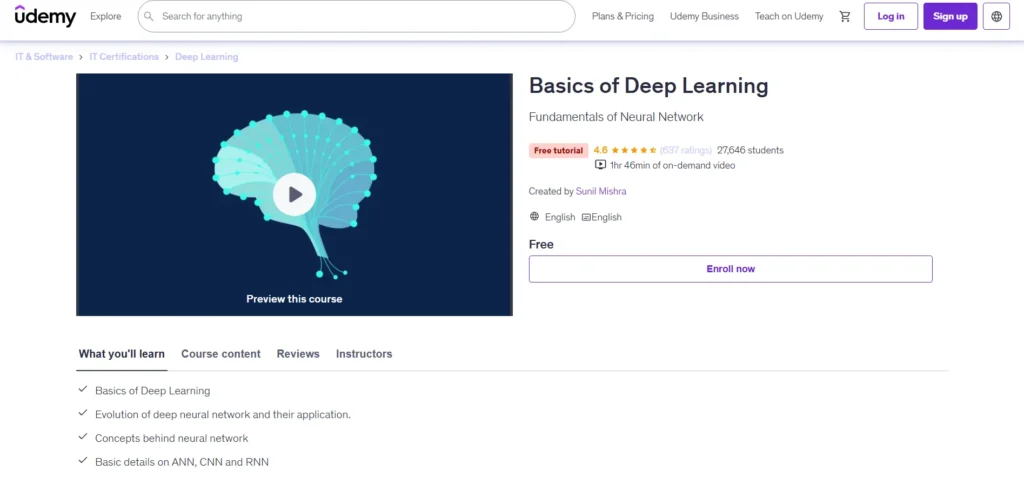
Before we dive into course details, it’s helpful to understand what makes Udemy a popular platform for learning deep learning.
1. Wide Range of Content
Udemy offers a diverse range of deep learning courses, each focusing on different aspects of the field.
You’ll find courses for all skill levels, from foundational introductions to more advanced topics like convolutional neural networks (CNNs) and generative adversarial networks (GANs).
This range ensures that regardless of where you are in your deep learning journey, there’s something for you.
2. Affordable Pricing with Frequent Discounts
Udemy’s pricing model is one of its key attractions. The platform operates on a pay‑per‑course basis, meaning you don’t have to commit to a subscription.
Moreover, Udemy often offers heavy discounts, making high‑quality courses affordable, sometimes even costing as little as $10–$20 per course during sales.
3. Lifetime Access
One of the most appealing features of Udemy courses is lifetime access. Once you purchase a course, you can revisit the material as often as you like. This is a great benefit, especially for complex topics like deep learning, where you may need to refer back to lessons as you advance in your learning.
4. Flexibility and Self-Paced Learning
With Udemy, you can learn at your own pace. There are no deadlines or rigid schedules, so you can take your time to absorb the material. This is perfect for people with busy lives who want to learn in their spare time.
5. Hands-On Projects and Practical Exercises
Udemy’s deep learning courses are known for their practical, hands‑on approach. In many courses, you’ll code along with the instructor and work on projects that help solidify your learning.
This is particularly useful when you’re learning a technical subject like deep learning, where theory alone isn’t enough—you need to apply what you’ve learned.
Getting Started with Deep Learning on Udemy

When you first dive into a Udemy deep learning course, you can expect to begin with an introduction to the basics of machine learning and deep learning. Let’s look at what this typically includes.
1. The Fundamentals of Deep Learning
The first few lessons of a deep learning course usually cover the basic concepts of machine learning and deep learning. These include:
- Artificial Neural Networks (ANNs): The building blocks of deep learning, where you learn how neural networks are structured and function.
- Supervised Learning: A popular method where you train models on labeled data to make predictions or classifications.
- Unsupervised Learning: A method where the model learns patterns from unlabeled data, often used for clustering and dimensionality reduction.
- Activation Functions: These are functions that determine whether a neuron should be activated, influencing the learning process.
Understanding these foundational ideas helps you grasp how deep learning algorithms work, setting the stage for more advanced topics later in the course.
2. Setting Up Your Environment
Once you’ve learned the basics, you’ll typically spend some time setting up the necessary tools. This includes installing Python, TensorFlow, Keras, and other libraries needed to implement deep learning algorithms.
Though setting up your environment can sometimes be tricky, most Udemy courses include step‑by‑step instructions to ensure that everything works smoothly.
If you run into trouble, the Udemy community forums or course Q&A sections can be helpful for troubleshooting.
Diving Deeper: Key Topics in Udemy Deep Learning Courses

As you progress in your deep learning course, you’ll explore more advanced topics. Here are some of the key concepts you’ll encounter.
1. Feedforward Neural Networks
Feedforward Neural Networks (FNNs) are the most basic form of artificial neural networks. In this stage, you’ll learn how to design and implement simple neural networks for classification tasks.
These networks consist of an input layer, one or more hidden layers, and an output layer.
Through hands‑on examples, you’ll get to see how different layers of neurons work together to make predictions.
You’ll also understand how backpropagation helps the network learn by adjusting the weights of the connections.
2. Convolutional Neural Networks (CNNs)
CNNs are designed for tasks that involve image processing, such as image classification, object detection, and facial recognition.
These networks are composed of layers like convolutional layers, pooling layers, and fully connected layers.
A typical deep learning course will walk you through how CNNs detect features in images, using filters to focus on different aspects such as edges, textures, or shapes. You’ll also get to implement CNNs in TensorFlow or Keras and train them on image datasets.
3. Recurrent Neural Networks (RNNs)
RNNs are ideal for sequential data, such as time‑series data or text. These networks are used for tasks like sentiment analysis, speech recognition, and language translation.
In Udemy courses, you’ll learn about the architecture of RNNs, including Long Short-Term Memory (LSTM) networks, which help overcome the vanishing gradient problem in traditional RNNs.
By training models to recognize patterns in sequences, you’ll be able to apply deep learning to dynamic data.
4. Generative Adversarial Networks (GANs)
Generative Adversarial Networks have gained popularity in recent years due to their ability to generate new data samples, such as creating realistic images or videos.
A GAN consists of two neural networks—one generates data, while the other attempts to distinguish between real and fake data.
Learning GANs is an exciting part of many deep learning courses on Udemy. These models are complex, but through practical exercises, you’ll be able to generate new images or even videos, adding an exciting dimension to your deep learning knowledge.
Real-World Applications and Projects
One of the standout features of Udemy’s deep learning courses is the focus on practical applications. Throughout the course, you’ll be asked to build projects using real datasets.
These projects help reinforce what you’ve learned and give you tangible results that you can showcase.
Some examples of the projects you might work on include:
- Image Classification: Build a deep learning model that can classify images into different categories, such as identifying cats and dogs in photos.
- Text Sentiment Analysis: Train a model to classify text as positive or negative based on the sentiment expressed in the text.
- Stock Price Prediction: Use historical stock data to build a model that predicts future stock prices.
- Face Detection: Build a model that detects faces in images, a common task in computer vision.
These projects are not only fun but also provide valuable experience that can be added to your portfolio. They’re great for demonstrating your skills to potential employers or clients.
Learner Feedback: What People Are Saying
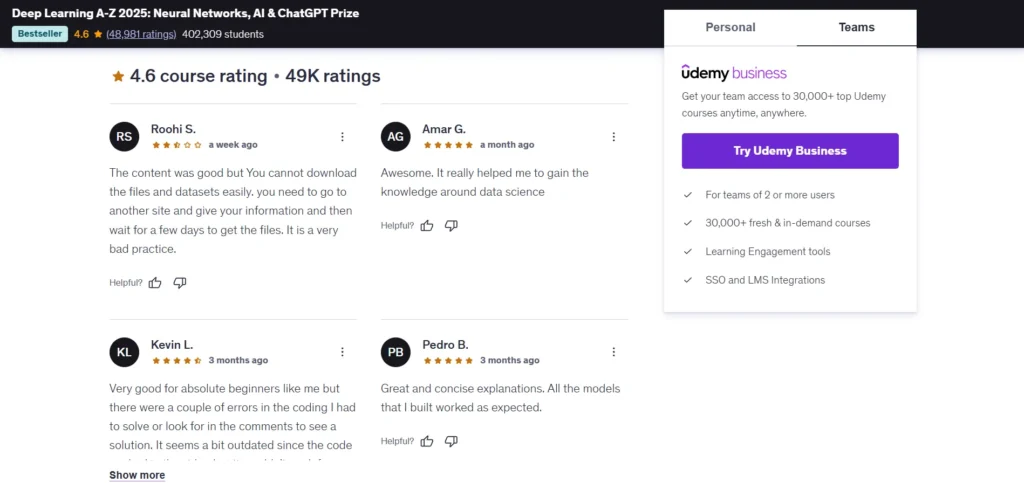
While Udemy offers a lot of great content, it’s important to consider real user feedback. Here are some of the common things people like and dislike about Udemy’s deep learning courses.
What Learners Like
- Comprehensive and Easy-to-Follow: Many learners appreciate how the courses break down complex topics into digestible lessons. The step‑by‑step instructions and clear explanations make it easy to follow along.
- Practical Approach: The focus on hands‑on projects and coding along with the instructor is a big hit. Learners enjoy building real models and solving problems as they learn.
- Beginner Friendly: A lot of users note that Udemy’s deep learning courses are accessible to beginners with some basic Python knowledge. While deep learning can be intimidating, the courses do a great job of easing students in.
What Learners Dislike
- Occasional Gaps in Content: While many courses are comprehensive, some users have pointed out that certain advanced topics, like advanced architectures or optimizations, are rushed or glossed over.
- Inconsistent Pacing: Some students feel that the pacing of the lessons can vary. Certain topics may feel rushed, especially for beginners, while others may be too slow.
- Limited Interaction: Unlike formal degrees or paid specializations, Udemy courses don’t offer live interaction with instructors. While there is a Q&A section, some learners feel that more personal engagement would be beneficial.
How Does Udemy Compare to Other Platforms?
Udemy is far from the only option for learning deep learning. Let’s briefly compare it to some other popular platforms.
1. Coursera
Courses like the Deep Learning Specialization by Andrew Ng on Coursera are highly regarded in the industry. They offer a deeper theoretical understanding and include peer‑graded assignments. However, Coursera’s subscription model can make it more expensive, and it’s less flexible in terms of pace.
2. Fast.ai
Fast.ai offers free, practical courses that are focused on getting students to build deep learning models quickly. However, they require more coding experience upfront and may not be as accessible to complete beginners.
3. edX
edX offers a range of deep learning courses from universities like MIT and Harvard. These courses are typically more academic in nature and are suited for learners who want to go deeper into the theory of machine learning and deep learning.
Final Thoughts: Is Udemy Right for You?
In summary, Udemy offers a great entry point for anyone looking to learn deep learning at their own pace. It’s particularly well‑suited for beginners who want to get hands‑on experience building deep learning models with minimal upfront cost.
The courses are comprehensive, affordable, and flexible, making them ideal for people with busy schedules who want to dive into the world of artificial intelligence.
While there may be occasional gaps in content or pacing issues, the hands‑on projects and lifetime access to courses are major benefits.
If you’re looking for a practical, easy‑to‑understand introduction to deep learning, Udemy is a fantastic option.
FAQs
What is deep learning on Udemy?
Deep learning on Udemy refers to online courses that teach machine learning techniques, such as neural networks, CNNs, RNNs, and GANs, using hands-on coding exercises and real-world projects.
Are Udemy deep learning courses suitable for beginners?
Yes, many Udemy deep learning courses are designed for beginners, offering step-by-step lessons starting with basic machine learning concepts and gradually progressing to more advanced topics.
Do I need prior programming knowledge to learn deep learning on Udemy?
Basic Python programming knowledge is recommended for most deep learning courses on Udemy, but some courses provide introductory lessons on Python to help beginners catch up.
How long do Udemy deep learning courses take to complete?
The duration varies, but most deep learning courses on Udemy range from a few hours to several weeks, depending on the depth of the material and your learning pace.
Can I access Udemy deep learning courses after completion?
Yes, once you purchase a course on Udemy, you have lifetime access to the materials, including any updates or revisions made to the course content.